


Content
Try for freeDressly's Meta ad strategy: 198,000 ads, 27 creatives
Growth
March 25, 2026
Growth
March 25, 2026

We analyzed 198,083 Meta Ad Library entries so you don't have to.

Katya Madonova
web2wave
We structured all 198,083 Ad Library entries for Dressly covering March 2025 through February 2026, and went through everything: where traffic goes, how creative is built and concentrated, what copy dominates, how testing works, and what the seasonal calendar looks like.
Scale: 198,083 entries, ~27 core creatives
Dressly ran 198,083 ad library entries over 12 months, built from roughly 27 unique core creatives (distinct body and title combinations). That is a ratio of approximately 7,300 ad instances per creative, one of the highest creative-reuse ratios in the dataset (Hypnozio ~561, Promova ~266).
This is not a volume-through-variety strategy. The creative output is extremely tightly controlled and distribution is what scales. A very small number of proven ideas get replicated across audiences, placements, and markets at high volume rather than being replaced with new concepts.
Geography: English-first, with structured LATAM bets
Language targeting across all 198,083 ads:
86.1% of ads ran in English, a concentrated language profile with Spanish and Portuguese together accounting for 13% of the library. Both have dedicated localized copy rather than translated ads: "Deja de comprar ropa y empieza a invertir en estilo…" for Spanish audiences and "Pare de comprar roupas e comece a investir em estilo…" for Portuguese. Five languages total, focused rather than broadly international.
Traffic destination: 87.6% web
Of 198,083 ads, 173,492 (87.6%) sent traffic to quiz.dressly.world, a single quiz and onboarding funnel domain. Dressly runs web-first acquisition: users go through a quiz on the web before they ever see the app. That means better attribution, no app store fee on every subscription, and a conversion flow they can update without an app release.
Top funnel paths by landing URL:
Almost all traffic goes to a quiz and onboarding experience, not a homepage or app store page. The quiz is the product entry point.
Funnel by locale: Amazon vs Mercado Libre
English audiences land on Amazon-branded funnel paths. Spanish and Portuguese audiences land on Mercado Libre paths. The funnel naming shows a different retail context built for each market, going beyond language adaptation into commerce-level localization. The same product and the same quiz structure, but a different commerce ecosystem framing depending on where the user is.
One message, scaled in three languages
The core hook “Stop buying clothes, start investing in style — with Your Smart Wardrobe Upgrade Plan 👗✨” appears in roughly 70% of all ads: 113,000+ instances in English, 17,400 in Spanish, and 8,145 in Portuguese. Dressly put their full creative weight behind one positioning and replicated it at scale across three markets, with no evidence in the data of parallel messaging experiments.
The 28-day plan that carried the whole funnel
The dominant creative frames the product as a time-bound wardrobe upgrade program with a daily structure: Day 1, Day 3, Day 7, through Day 28. The full creative that drove the most volume looks like this:
Body: "Stop buying clothes, start investing in style — with Your Smart Wardrobe Upgrade Plan 👗✨ Get daily outfit tips based on what's already in your closet. 🟢 Day 1: Find your style 🟢 Day 3: Style your go-to jeans 3 new ways 🟢 Day 7: Discover your power outfit … (28-day plan)"
Title: Take a 5 min quiz 👗
Landing: quiz.dressly.world → en/shop-amazon-smart-plan-hp
That creative ran for up to 47 days (the longest delivery window in the dataset) and is described in the data as the single pattern that both scales the most and runs the longest when it does run. 85.6% of all ads across the library used a single CTA: "Take a 5 min quiz👗." The offer is framed as a time-bound program with a visible daily structure.
Top 5 creatives by volume
These are the five creatives that ran the most ad instances across the full library.
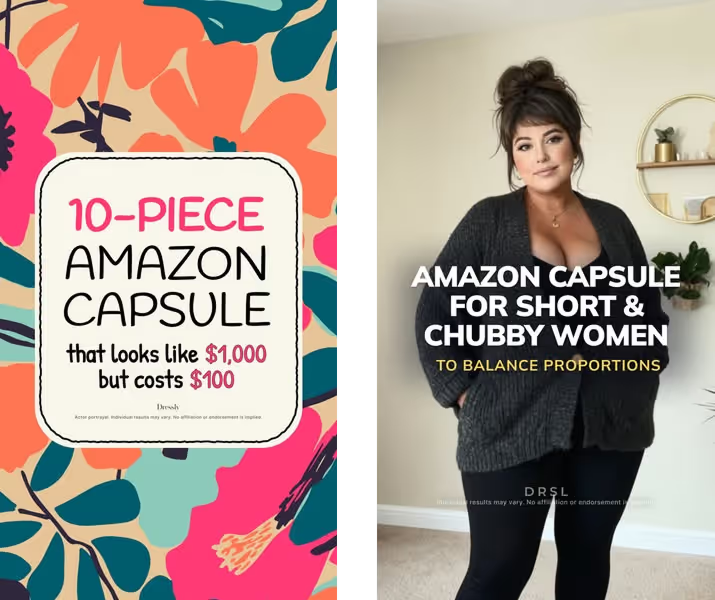
Message pillars: what the copy is actually about
The full breakdown of themes across the library:
Plan, personalization, and wardrobe dominate. Body type and fit and daily outfit are strong secondary pillars. Sale and discount themes appear in a small minority of ads. The copy is built around a structured program, not around shopping or trends.
Ad copy: long, structured, and emoji-heavy
Median copy length is 552 characters, with a mean of 543. 182,059 ads exceed 300 characters. Copy is built around bullet points, day-by-day breakdowns, and checkmarks. 90.2% of ads use emoji, used for structure and emphasis rather than decoration.
The step-by-step plan theme appeared in 88.2% of all ads, making it the single most dominant message pillar in the dataset. 12.6% of ads use numbers or statistics such as "28 days," "Day 1," or "5 min." Question hooks appear in only 1.5% of ads.
The top CTA words in body copy: style (172k ads), outfit (155k), build (150k), start (145k), get (144k), discover (125k), find (118k). The primary CTA lives in the link title rather than the body: "Take a 5 min quiz👗" on 169,599 ads (85.6% of the library).
Seasonal strategy: December and January carry the volume
Monthly launch cadence across the full dataset:
January 2026 was the single largest month at 44,280 ads launched, with December 2025 second at 28,469. The data notes this is consistent with holiday and "new year, new style" messaging patterns.
Dressly also ran a dedicated Black Friday creative ("Before You Shop This Black Friday… 🖤") with 16,006 instances, the fourth largest hook in the dataset by instance count and the only large-scale seasonal hook in the set.
How fast they turn off ads
Testing velocity across the full library:
Lifespan distribution:
80.3% of ads were turned off within one day. 97.4% within three days. The model is clear: launch many variants fast across a highly concentrated set of creatives, cut aggressively, and concentrate on the small fraction that earns a longer run. The 47-day "Smart Wardrobe Upgrade Plan" creative is the primary example of what survives that filter.
Platforms: full Meta placement set with Threads in one in three ads
All 198,083 ads ran across Facebook, Instagram, Audience Network, and Messenger. Threads appeared in 62,186 ads, or 31.4% of the library, roughly one in three entries across the full dataset.
What the data shows about scaling a fashion app on Meta
Dressly's strategy across this 12-month period comes down to a set of structural decisions, each of which reinforces the others.
Send traffic through a web quiz funnel rather than the App Store. Build the entire creative library around one core message and replicate it at scale rather than testing many concepts in parallel. Frame the product as a time-bound plan with visible daily structure. Localize into separate market contexts with different commerce framing rather than just translating copy. Launch at very high volume, turn off most ads within 24 hours, and sustain only the creatives that earn a longer run. Concentrate the seasonal push into the December and January window while running a purpose-built Black Friday entry point.
None of these ideas are individually novel. What stands out in the data is the consistency and precision with which Dressly executes all of them together, across three languages, across multiple funnel paths, over the course of a full year.
Web-to-app funnels are exactly what web2wave builds. We design and optimize the full acquisition flow, from the ad hook through the quiz and landing page to conversion, for mobile apps that are serious about scaling on paid social. If you want to see what a properly built web2app funnel could do for your app, book a call with our team.
Share this Article
Build your web funnel with web2wave
Start using web funnels: Launch faster, convert better, and keep more revenue with no app store limitations

.webp)