Content
Try for freeAI Localization: Translate Your Whole Funnel Into 40+ Languages in One Click
October 15, 2025
October 15, 2025
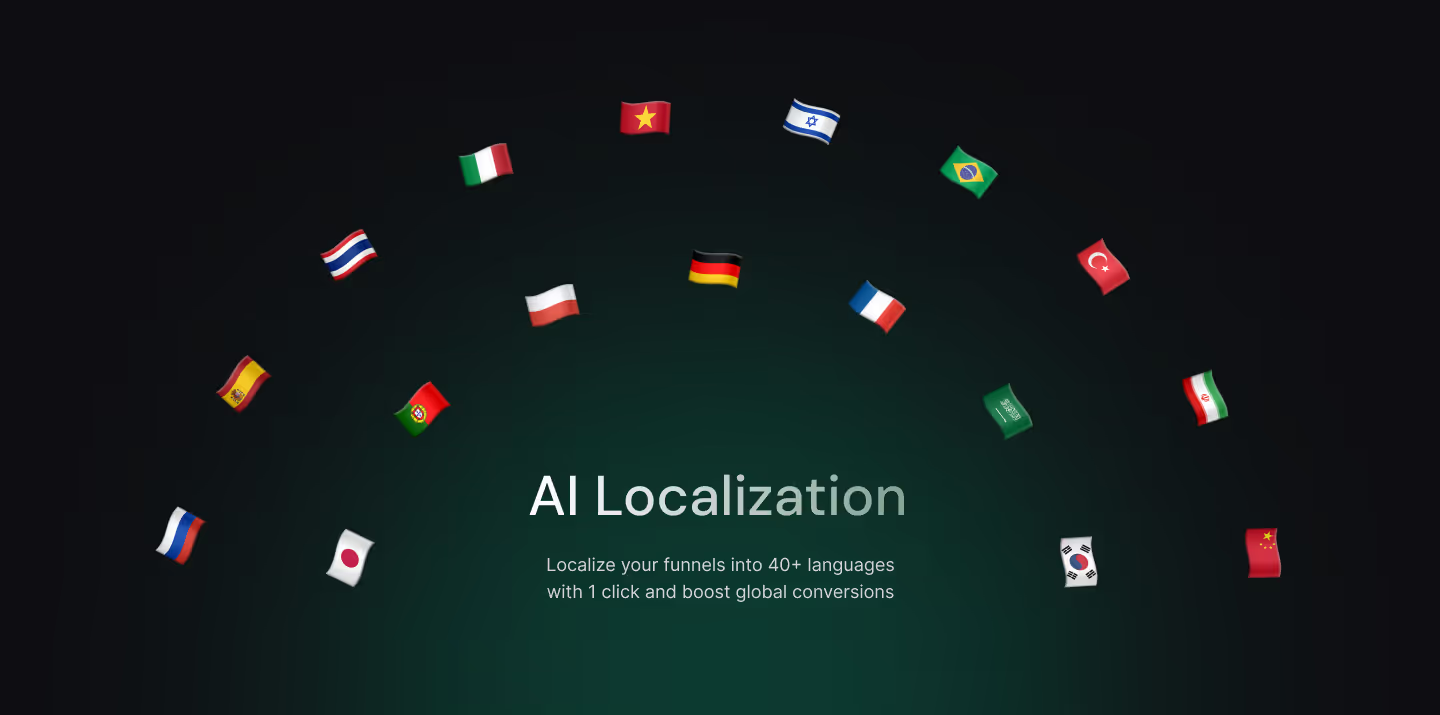

AI localization is the use of machine translation models to adapt a product's text, formats and flow to another language and market, rather than translating strings one by one by hand. In web2wave it applies to the whole web2app funnel: quiz screens, results pages, paywalls, system messages and email sequences are duplicated into a target language in one click, with layout, branching logic and tracking left intact. Supported languages: 40+.
This matters for subscription apps because paid traffic is rarely only English. An ad account that works in the US will usually find cheaper or less contested inventory in Germany, Brazil, Japan or France, but only if the funnel the click lands on is in the visitor's language with the visitor's currency. Building and maintaining a separate funnel per market by hand is the cost that stops most teams; AI localization removes most of it. This page explains what gets localized, how routing works, how it compares with the alternatives, and what to measure.
What AI localization is, and how it differs from translation
Translation produces the same sentence in another language. Localization produces a working version of the product for another market: the text, but also number and date formats, currency, button labels, validation errors, legal checkboxes and the emails that follow. AI localization automates that production step with a language model and keeps the result linked to the source so that updates can be re-applied.
The practical test is whether a German user can go from the first quiz screen to a paid subscription and a welcome email without seeing English. If any step falls back to the source language, the funnel is translated, not localized, and that step is where drop-off concentrates.
What gets localized in a web2app funnel
- Quiz and onboarding screens. Every question, option, progress label and insight screen; branching conditions and variables stay the same.
- Results and plan pages. Dynamic text that depends on answers is translated with the templates.
- Paywalls. Plan names, feature lists, proof blocks and timers, with currency by country handled separately in the paywall builder.
- System messages. Buttons, error messages, form validation, loading states and notifications, so the UI is consistent, not just the content.
- Email sequences. The sequence is sent in the language the user was detected in, with separate statistics per language.
Each language version gets its own URL and quiz ID, which is what makes per-market analytics and SEO possible later.
How it works in web2wave
- Build the source funnel. Create the quiz and paywall in one language with the quiz builder.
- Duplicate and pick a language. Choose the target language; the AI translates all screens, preserves layout and adapts to different text lengths.
- Review. Preview every screen in the new language, check the payment flow in the target currency, and edit anything that reads wrong. Brand terms and product names can be kept as they are.
- Turn on routing. Enable language-based or country-based auto-redirect (Advanced plan) or add a manual language switcher block (all plans).
- Keep versions in sync. Translations are linked to the source. Change the main funnel and push the update to all language versions in one click; version history is kept per language.
- Track per market. Each version reports its own conversion, so you can see which languages pay back the ad spend.
Routing users to the right language and pricing
Two routing modes are available, and they can be combined. Language-based routing reads the browser language: a French browser is sent to the French funnel, regardless of location. Country-based routing reads the IP location: a visitor in Germany gets the German funnel and EUR pricing, a visitor in the US gets English and USD. Country routing is the one to use when pricing differs by market, language routing when the audience is spread across countries. A manual switcher lets users override either choice without a page reload, and analytics update to the new language automatically.
AI localization vs manual translation vs browser auto-translate
- Time to a new language. AI localization (web2wave): Minutes, then review; Manual translation agency: Days to weeks per language; Browser auto-translate: Instant, uncontrolled
- Covers system text and emails. AI localization (web2wave): Yes; Manual translation agency: Only if specified and wired by developers; Browser auto-translate: Page text only, not emails
- Layout and logic preserved. AI localization (web2wave): Yes, linked to source; Manual translation agency: Depends on implementation; Browser auto-translate: Often breaks layout
- Updating after a copy change. AI localization (web2wave): One-click re-sync; Manual translation agency: New order each time; Browser auto-translate: n/a
- Routing and local pricing. AI localization (web2wave): Built in; Manual translation agency: Separate development; Browser auto-translate: None
- Quality control. AI localization (web2wave): Preview and edit per screen; review by a native speaker for key markets; Manual translation agency: High, if the brief is good; Browser auto-translate: None
The sensible workflow for a team with paid traffic is AI first, native-speaker review on the three or four markets with real spend, and manual translation only for legal copy that requires it.
Where AI localization pays off first
Not every market deserves a full launch, and localization should follow the ad data, not precede it. A practical order for a subscription app:
- Markets where you already have impressions in the local language. If search or ad reports show German or Portuguese queries hitting an English funnel, those visitors are already paying for the click and dropping on the first screen.
- Markets with lower ad costs in your category. A localized funnel is what turns cheaper inventory into comparable conversion; without it the lower cost per click is lost to a higher drop-off.
- Markets your app already supports. If the app UI is in Spanish, the funnel should be too; otherwise the paid user meets a language switch after the purchase.
Because a new version takes minutes rather than weeks, the cost of testing a market is mostly the ad budget. That changes the decision from "which three languages do we translate" to "which languages do we keep after the first two weeks of data".
Measuring localized markets
Because each language version has a unique URL and quiz ID, you can compare quiz completion, paywall conversion and refund rate by language, and send the right UTM-tagged version to each ad set. Pixels and attribution connect through integrations so Meta and TikTok optimize on purchases from the right market. A language that converts well with low ad costs is a signal to invest in a native review and a dedicated creative set; a language that does not convert is a cheap experiment to switch off.
What localization did for Leya AI
Leya AI used web2app localization on web2wave to take one funnel into multiple languages. The case study published on the web2wave blog reports that the funnel scaled roughly tenfold after localization, with the same base quiz and paywall running per market and per-language analytics used to decide where to add budget. The mechanism was not a better funnel; it was the same funnel made available to more buyers in their own language.
FAQ
What is AI localization?
Using machine translation models to produce a working version of a product for another language and market, including UI text, formats, emails and routing, with the translation linked to the source so updates can be re-applied. In web2wave it covers the entire quiz-to-paywall funnel.
How many languages does web2wave support?
More than 40, covering the major world languages. A new language version is created by duplicating the funnel and selecting the target language.
Can users be sent to their language automatically?
Yes. Auto-redirect by browser language or by country is available on the Advanced plan. A manual language switcher block works on all plans and lets users override the detection.
Does localization change pricing too?
Currency and price by country are set in the paywall builder and combined with country-based routing, so a visitor sees local language and local pricing together.
What happens when I update the original funnel?
Translations are linked to the source. You change the main version and push the update to all language versions in one click. Version history is kept per language.
Want to see your funnel in another language before you spend on it? Book a 30-minute demo and we will localize a sample flow live, or start free and try one-click translation on your own quiz.
Share this Article
Build your web funnel with web2wave
Start using web funnels: Launch faster, convert better, and keep more revenue with no app store limitations