


Content
Try for freePromova's Meta ad strategy in 2025: 80K ads, 304 creatives
Growth
March 10, 2026
Growth
March 10, 2026

We analyzed 80,752 Meta Ad Library entries so you don't have to.

Katya Madonova
web2wave
We structured all 80,752 Ad Library entries for 2025 for Promova, a language learning app, and went through everything: where traffic goes, how creative is built and refreshed, what copy dominates, how testing works, and what the seasonal calendar looks like.
Promova's primary product teaches English, with separate offerings for French and Spanish. It targets adults who want to speak more fluently, move up in their careers, or open up new markets. The numbers behind their 2025 ad operation are worth going through carefully.
Scale: 80,752 entries, ~304 core creatives
Promova ran 80,752 ad library entries in 2025 built from roughly 304 unique core creatives, distinct body and title combinations. That is a ratio of approximately 265 ad instances per creative.
The implication is straightforward: this is not a volume-through-variety strategy. The creative output is tightly controlled and the distribution is what scales. A small number of proven ideas get replicated across audiences, placements, and markets at high volume rather than being replaced with new concepts.
Geography: English-first, with structured expansion bets
The language breakdown across all 80,752 ads:
93.6% of ads ran in English. That is a more concentrated language profile than most apps we have analyzed, and a deliberate one. Promova is running an English-dominant acquisition model with specific, funded expansion bets placed elsewhere.
Those bets are real. Korean, Japanese, and Chinese together account for ~1.4%, each with localized creatives rather than machine-translated copy. Spanish has its own dedicated product domain. French has its own funnel architecture. The non-English tail is thin but it is not accidental.
Traffic destination: web funnels carry almost everything
Of 80,752 ads, roughly 1.9% went directly to the App Store (1,386 to Google Play, 126 to iTunes). Everything else went through web-based conversion pages.
The primary destination, receiving 61,700 ads and 76.4% of the library, was english-improve.com, a domain that does not appear in Promova's brand presence.
Full destination breakdown:
Web-to-app funnels account for over 80% of the ad library by volume. The App Store is a minor destination, not the primary one.
The stealth domain strategy
The caption users see in 59,824 ads is promova.com while the actual landing URL is english-improve.com. The brand domain and the performance domain are completely separate: users recognize the brand name, but the page they land on has no connection to it.
76.8% of all ads show promova.com in the caption while sending traffic somewhere else:
Keeping the performance domain separate means the conversion page can be rebuilt, tested, and optimized without any of that touching brand perception, SEO rankings, or direct traffic behavior on the main site. It also reveals the full scope of what Promova is running: English learning, Spanish learning, an AI tutoring product, and an affiliate channel, all routing through the same brand caption.
46% of the entire library came from one creative hook
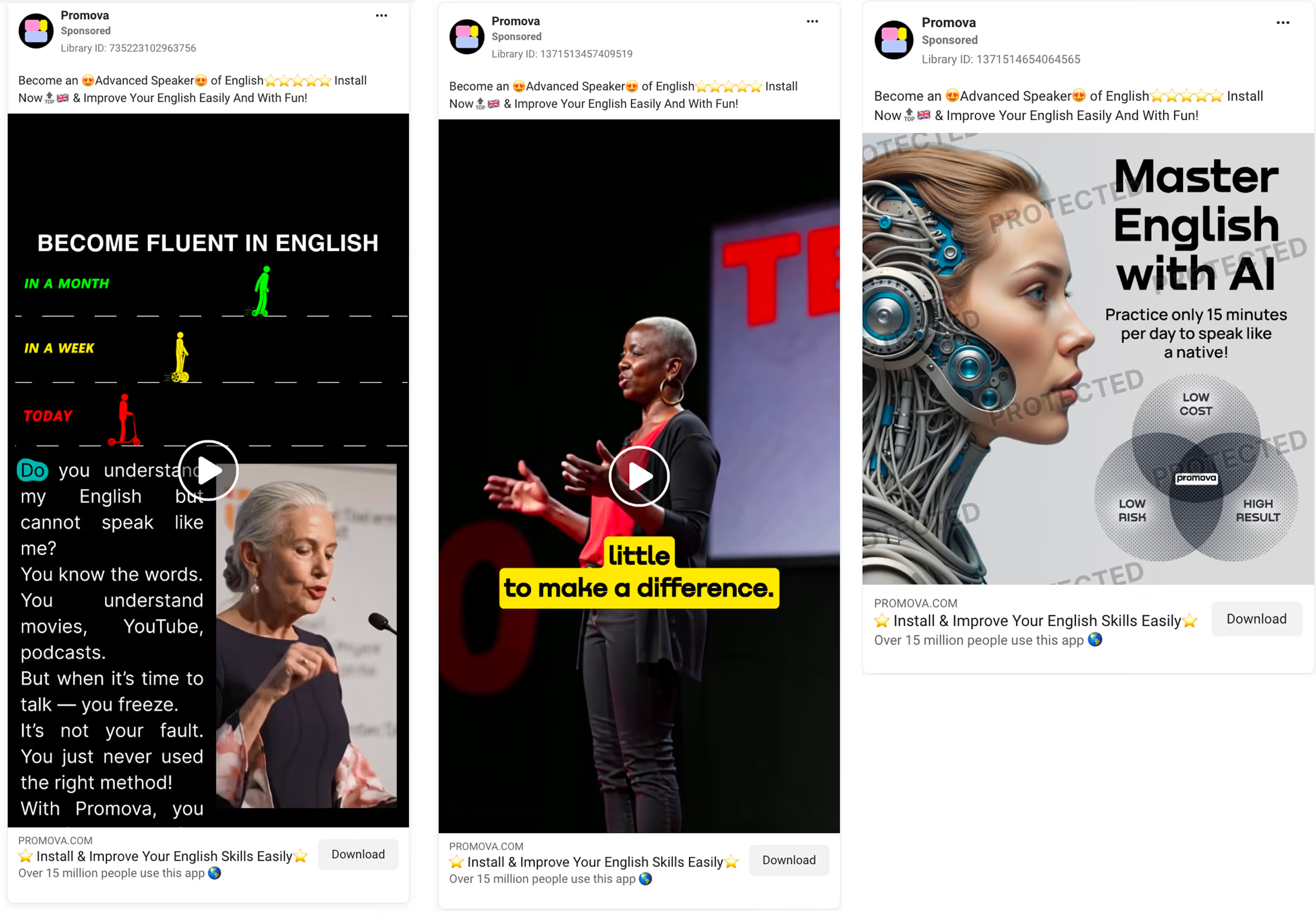
One creative family accounts for nearly half of the dataset: the same hook, title, and description pattern repeated in 37,151+ ad instances.
- Body: “Become an 😍Advanced Speaker😍 of English⭐️⭐️⭐️⭐️⭐️ Install Now🔝 & Improve Your English Easily And With Fun!”
- Title: ⭐️ Install & Improve Your English Skills Easily⭐️
- Description: Over 15 million people use this app 🌎
That is a clear concentration play: one aspirational message (advanced speaker + install now + social proof) scaled through micro-variations and localizations rather than many different hooks. The same pattern appears in Portuguese and other languages, so the bet is on one message family, not a broad mix of concepts.
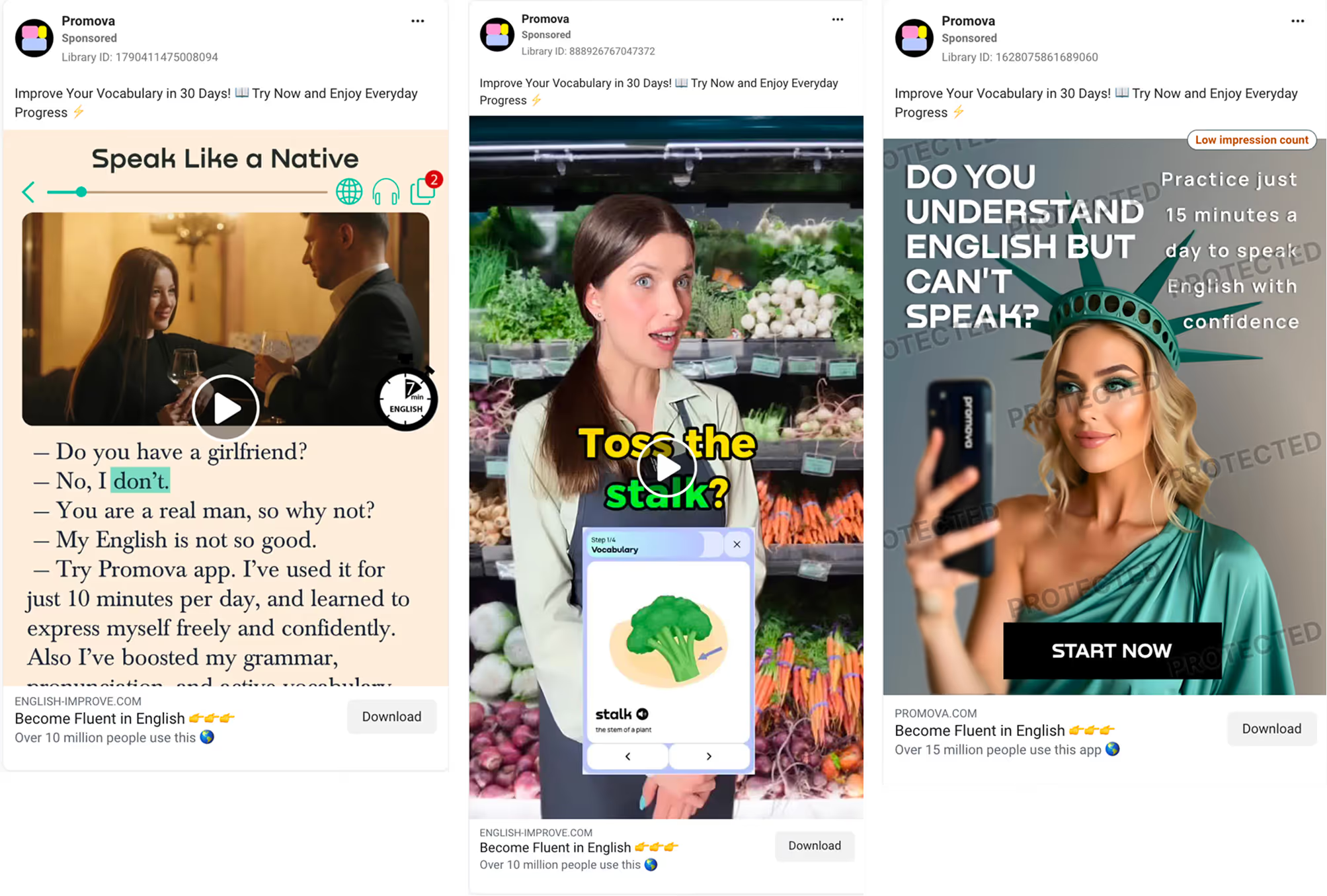
A second, distinct hook in the library, "Improve Your Vocabulary in 30 Days! 📖 Try Now and Enjoy Everyday Progress ⚡️," shows the same copy formula: short, emoji-heavy, outcome plus CTA plus urgency. So the takeaway is both the dominance of this one hook and the consistent type of creative (short, aspirational, social-proof-driven) across the library.
How they keep the same creative running without fatiguing it
When an ad instance stops, the next micro-variation launches the same day in 87.6% of cases, and the copy stays the same. The user count in the description gets updated, the emoji sequence shifts slightly, a new ad ID is created, but the message is functionally identical.
Gap analysis across 3,506 consecutive creative instances:
Each new instance resets Meta's ad learning while keeping the proven message in market. The creative production infrastructure runs at near-zero latency: there is no resting period between runs, and no gap where the message goes dark.
Social proof updated in real time as the user base grew
One of the more operationally interesting details in the data is in the description field. Promova systematically updated their user count claims across new ad instances as their actual user base grew throughout 2025:
The same creative gets relaunched with an updated number each time the real user count crosses a new threshold. The social proof stays accurate, the momentum signal stays visible, and each relaunch generates a new ad ID, which also partially explains the high volume of near-identical entries in the library.
Ad copy: short, emoji-heavy, built around two words
Median ad body length is 108 characters, mean is 121. Only 16 ads in the entire library exceed 300 characters. This is a deliberately compressed format; most app advertisers run significantly longer copy.
97.5% of ads contain emoji, making it a structural brand convention rather than an occasional creative choice.
The word frequency data is revealing:
"Speak" in 54% of all ads is not incidental. Promova's core promise is speaking fluency, not vocabulary, grammar, or comprehension. That distinction is embedded structurally in the copy across almost the entire library. "Now" in 61.8% of ads reflects a CTA philosophy built around immediacy. The template is consistent: aspirational identity, urgency word, social proof number, kept short enough to hold attention in a feed.
The four main creative pillars
One hook dominates the volume, but the library is built around four distinct audience segments:
The frustration hook ("Tired of boring English learning? 😴") targets people who have already tried something else and found it tedious. The 1 Month hook targets the time-constrained segment with a concrete speed promise. Both run alongside the dominant aspirational creative and address different entry points into the same product.
The career-focused funnel
9.7% of all ads (7,805) carry professional or career messaging, with a dedicated landing page at english-improve.com/o/english-for-work. The title "Climb the corporate ladder 📈" appeared on 7,189 ads, the second most used title in the entire dataset.
This is a parallel acquisition channel running alongside the consumer funnel, not a side test. It targets people motivated by career advancement, a segment with higher intent and a different reason to convert. The audience warrants its own landing page and its own creative family, both of which were active across 2025.
The Foxtrot funnel system
Three "foxtrot" URLs appear in the data, each serving a different purpose.
The primary foxtrot URL, promova.com/foxtrot/f40-bro-fr2, received 2,799 ads and is almost entirely the French learning product. The top hook, "Improve Your French FAST and EASY🔝", ran 2,561 instances. The targeting is 100% English-speaking audiences, meaning these are English speakers learning French rather than native French speakers. This product lives behind its own dedicated funnel rather than the main BM funnel used for English.
A second foxtrot URL, promova.com/foxtrot/quantum-f-rem, ran 42 ads between November 21 and December 5 with an 80% off discount. A contained 15-day Black Friday burst campaign with no evergreen creative, shut down immediately after the window closed.
A third foxtrot appeared on a separate domain: promova-english-academy.com/foxtrot/ai-tutor, with 18 ads, a minimal test of an AI tutoring product.
The pattern across all three is consistent: foxtrot is Promova's internal framework for incubating new products and testing experimental copy before they earn their own full infrastructure. The French product ran 2,799 ads through foxtrot while the English product ran 61,700 through the main BM funnel. Based on the data, the separation appears deliberate.
Testing speed: launch fast, cut within a week
Methodology note
The Meta Ad Library does not include impression, reach, or spend data. Where delivery duration is mentioned, it refers to how long an ad remained open in the account, not to reach or spend.
79.5% of all ads were turned off within 7 days of creation. The median lifespan across the entire library is 3 days.
94 ads (0.1%) ran for 6 months or longer. Those 94 are the creative decisions Promova had the highest conviction in, and they re-ran them in micro-variations throughout the year. The logic is volume-in, fast-out: spin up many ads, cut aggressively, concentrate budget on the small fraction that holds.
Threads adoption
51.4% of all ads (41,492) ran on Threads, among the highest adoption rates we have seen in the app category. Threads is always bundled with Facebook, Instagram, Messenger, and Audience Network. No ads run on Threads as a standalone placement.
Lifespan comparison by placement type:
The long-tail difference is the sharpest signal. Only 1 Threads ad ran 180+ days versus 93 without Threads. Promova's longest-running evergreen creatives perform their best on the legacy four platforms. Threads extends reach at lower marginal cost and picks up audiences that are less saturated on Facebook and Instagram, but the highest-conviction ads are sustained elsewhere.
Seasonal timing: spring is the primary push, not January
The launch cadence runs counter to what most subscription apps do. Peak creation months were March, April, and May, each generating 10,000 to 11,500 new ad instances. January had 775.
The January spike in CPMs from Q4 competition and New Year resolution campaigns does not appear in Promova's data. They let that cycle pass at full price, then ramp hard into spring when competition thins and purchase intent remains high.
Discount strategy: three waves, with the deepest cut held for last
Promova ran structured promotional campaigns across three periods in 2025:
Spring peaked in April, summer peaked in June, and Q4 built steadily from October through year-end. Discount ads have a shorter mean lifespan than non-discount ads (6.1 vs 7.9 days), confirming they are treated as short bursts of high spend rather than evergreen campaigns.
The discount depth is also tiered by season. 50% Off and 40% Off appear in spring and summer. The 80% Off offer ran on only 103 ads, confined entirely to the quantum foxtrot funnel between November 21 and December 5, a 15-day Black Friday and Cyber Week window. The deepest discount reserved for the highest-competition period of the year, deployed briefly and pulled immediately after.
January sits at 26 discount ads. The New Year motivation cycle runs at full price.
Multi-product expansion
By 2025, Promova was running at least three distinct products through separate web domains, all displaying promova.com as the ad caption:
- english-improve.com — English learning, the core product, 76.4% of all ads
- spanish-boost.com — Spanish learning, 2,128 ads
- promova-english-academy.com — AI-powered English tutoring, tested at 18 ads
The Spanish product's performance data is worth noting separately. Its best creative averaged 92 days of delivery against an overall dataset mean of 7.5 days. That gap signals early product-market fit. The hook that drove it: "Open the doors to communicate with the 400 million Spanish speakers of the World."
What the data shows about scaling a language app on Meta
Promova's 2025 strategy comes down to a set of structural decisions, each of which compounds the others.
- Send traffic through web funnels rather than the App Store.
- Keep the brand domain and the performance domain completely separate.
- Identify one hook that converts and scale it through micro-variation rather than constant creative rotation.
- Refresh social proof in real time.
- Run high launch volume, cut most ads within a week, and concentrate budget on the small fraction that survives.
- Use Threads for reach rather than performance.
- Deploy discounts in waves with the steepest offers reserved for Q4.
None of these ideas are individually new. What stands out in the data is the consistency and precision with which Promova executes all of them together, across multiple products, over the course of a full year.
Web-to-app funnels are exactly what web2wave builds. We design and optimize the full acquisition flow, from the ad hook through the quiz and landing page to conversion, for mobile apps that are serious about scaling on paid social. If you want to see what a properly built web2app funnel could do for your app, book a call with our team.
Share this Article
Build your web funnel with web2wave
Start using web funnels: Launch faster, convert better, and keep more revenue with no app store limitations
.webp)