


Content
Try for freeHow a hypnotherapy app built a 60,000-ad machine on Meta
Growth
February 24, 2026
Growth
February 24, 2026

An in-depth analysis of 60,039 Meta ad library entries by web2wave

Katya Madonova
web2wave
At web2wave, we track how mobile apps grow on paid social. We pulled and structured 60,039 Meta ad library entries for Hypnozio in 2025, and what came out of that analysis is genuinely worth paying attention to, whether you run a health app, manage paid acquisition, or are simply trying to understand what modern performance marketing looks like at scale.
Hypnozio is a hypnotherapy app built around science-based audio sessions. It targets people dealing with specific, named problems: binge eating, alcohol use, stress, poor sleep, and low confidence. And it has figured out how to reach them on Meta in a way that most apps have not.
Scale: 60,000 entries, 107 core creatives
The first thing that stands out in the data is the gap between volume and variety. Hypnozio has 60,039 ad library entries for 2025, but only around 107 unique core creatives in terms of distinct body and title combinations. That means the scale is not coming from producing thousands of original concepts but from taking a small set of proven ideas and recombining them across languages, audiences, and placements at high volume.
This is an important distinction: the creative output is disciplined and concentrated, the distribution is what scales.
Geography: English first, then a genuinely global footprint
Using language as a proxy for geographic reach, the breakdown looks like this:
English leads at 35.6%, followed by Spanish at 21.7% and French at 11%. What is notable is the depth of the localization effort: 19 languages in total, including Hebrew, Turkish, Japanese, Arabic, Norwegian, and Finnish. This is not a translate-and-forget approach. Each language maintains sustained ad volume, which suggests dedicated campaign management per market rather than automated spillover.
Traffic destination: Web-to-App funnels, not the App Store
Of the 60,039 entries, 59,992 link to hypnozio.com. Based on the data, Hypnozio did not run direct-to-app campaigns in 2025. The entire paid acquisition strategy runs through web quiz funnels, with dedicated landing pages per problem segment: landing-sl for sleep, landing-alc for alcohol, landing-mc and landing-proc for other categories.
This is a deliberate strategic choice, not an oversight. Web2app funnels tend to attract higher-intent users and generate cleaner purchase signals for Meta's algorithm compared to direct App Store links. For a product like Hypnozio, where the user needs to understand the offer and connect it to their specific problem before converting, a quiz funnel does a lot of the selling work before the download ever happens.
Ad copy: Selling a diagnosis, not a feature
Their ads don't sell features, they sell you a diagnosis. The copy identifies the user's problem with enough precision that reading the hook feels like being seen.
Look at the top-performing examples:
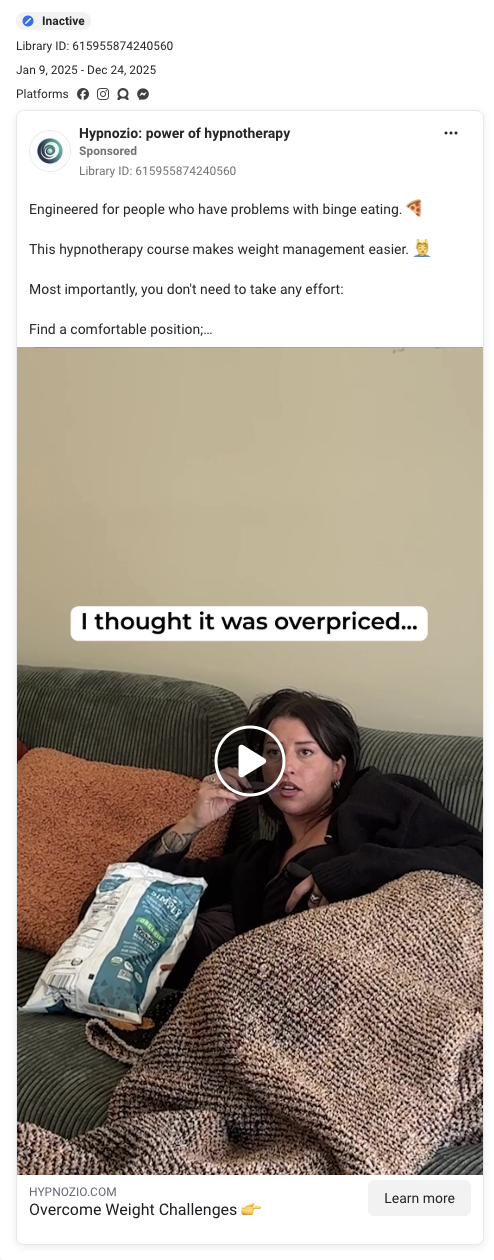
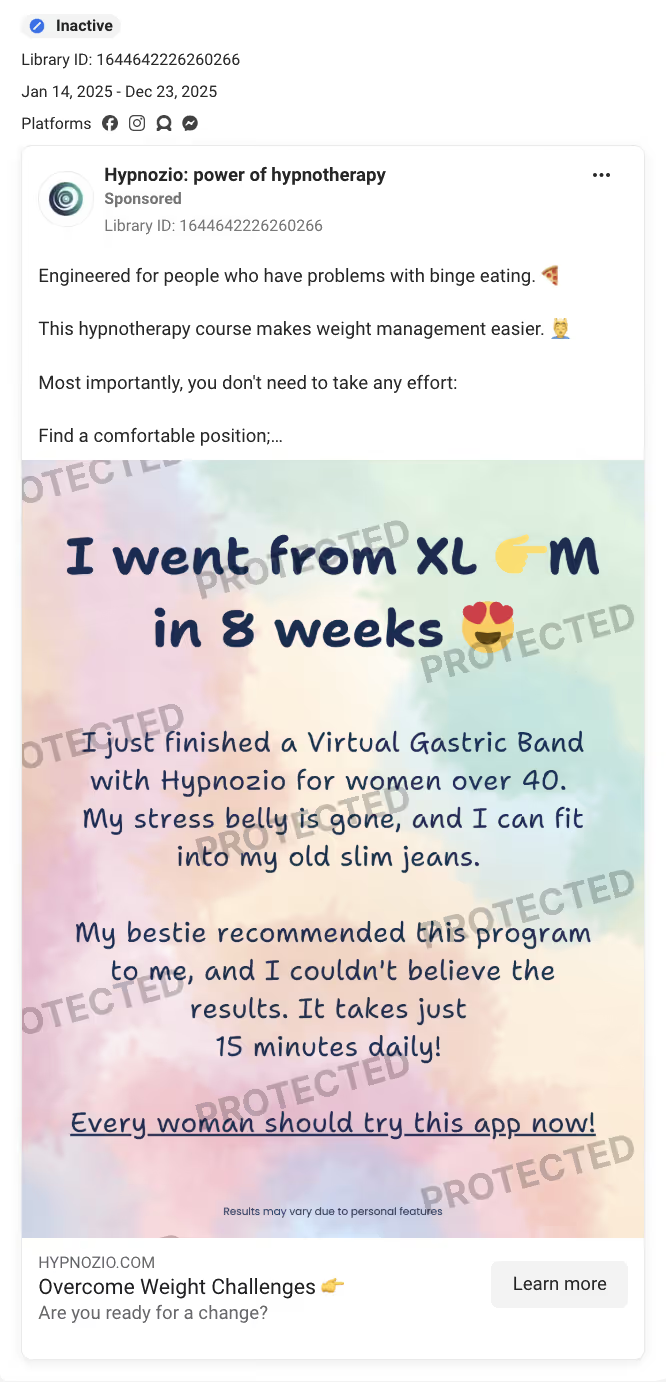
- "Engineered for people who have problems with binge eating. 🍕"
- "10 Years ⏳ That's how much of your life you'll lose under the influence of alcohol. It's time for a change!"
- "Feeling drained? Stressed? Struggling to lose weight...?"
The pattern across winning ads is consistent: a problem-specific hook that names the pain, an outcome tied to weight or alcohol or another concrete issue, an ease-of-use framing ("no effort," "just put on headphones," "feel results instantly"), and a direct CTA. The copy is medium length, with a median of around 336 characters and a mean of about 401, which is long enough to build context and short enough to survive a scroll.
Social proof appears in roughly 10.8% of ads, used selectively rather than as a default. The most common form is a statistic paired with a testimonial, for example: "94% of our customers successfully broke free from alcohol consumption after just a few sessions." Strong CTAs built around the words "free," "discover," and "join" appear in 7,559, 5,623, and 5,463 ads respectively.
Creative strategy: One idea, many versions
The two main offer pillars in the data are weight and binge eating, which accounts for around 24,000 ads, and alcohol, which accounts for around 6,600. Secondary themes include stress (2,178 ads), confidence (1,440), sleep (1,354), and habit-breaking language, which appears in about 8,273 ads under variations of "break free" and "habit."
Link titles follow the same segmentation logic: "Overcome Weight Challenges," "Break Free from Alcohol Addiction," and their translations in every active language. The 👉 emoji appears consistently across titles as a visual CTA marker.
One app, but a completely different hook for every pain point and audience segment.
Testing cadence: Fast launch, faster kill
The testing strategy is aggressive and disciplined at the same time: the median ad lifespan is 4 days, the mean is 8.9 days. Around 69.4% of all ads, which is 41,682 entries, are stopped within 7 days of creation. Within 30 days of creation, 58,208 ads have been turned off.
The lifespan distribution breaks down like this:
Measured by delivery duration (from delivery start to delivery stop).
The whole strategy is: launch at volume, cut losers within a week, scale what holds. Most ads are short-lived by design. The question being asked at the start of every campaign is not "will this work" but "how quickly can we find out."
Top creatives: What survives 180+ days
The longest-running ads in the dataset reach up to 349 days. The top survivors, the ones that run for half a year or more, are almost entirely binge eating and weight creatives followed by alcohol.
Of the 274 ads that ran 180 days or more, only 9 are English-language creatives: 6 alcohol and 3 weight and binge eating. The rest are localized versions of the same hooks across French, German, Spanish, Polish, and other markets.
These are not just the best-performing creatives in terms of conversion. They are also the ones that Meta kept serving without flagging or fatiguing, which tells you something about how sustainable the angle is as an acquisition hook.
Below are 7 English creatives that cleared the 180-day mark.
Alcohol (4 ads)
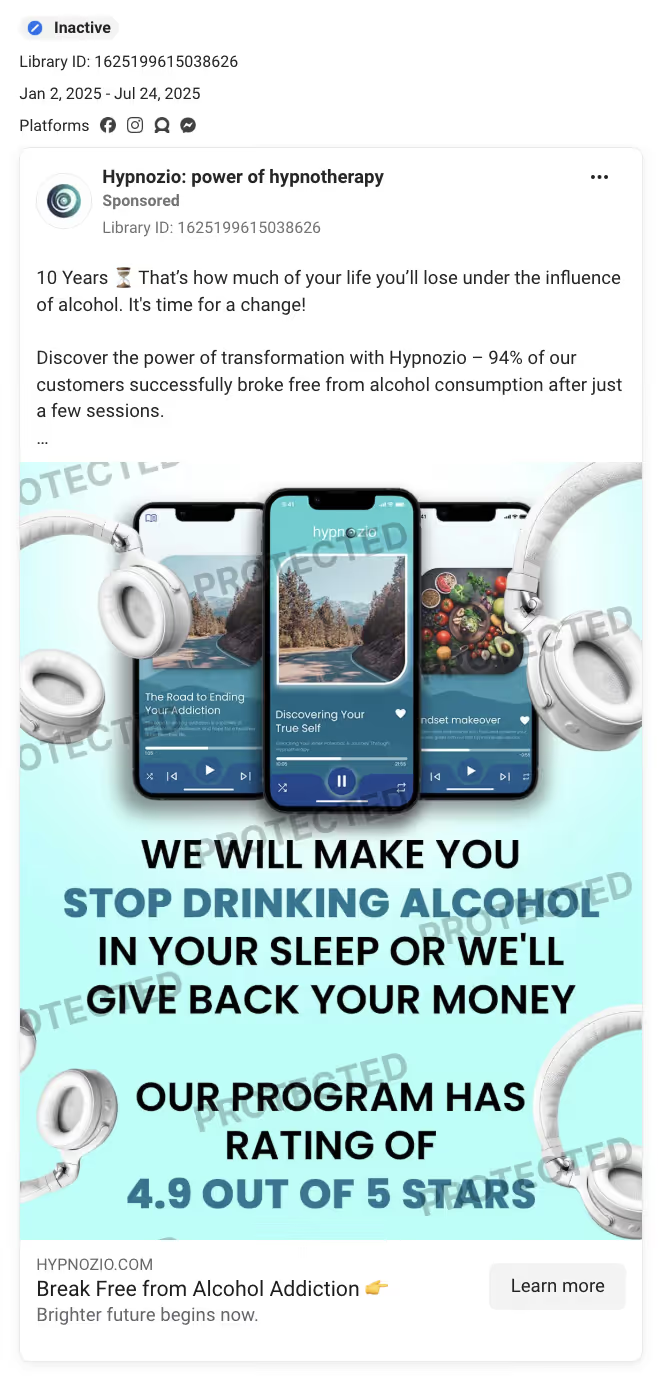
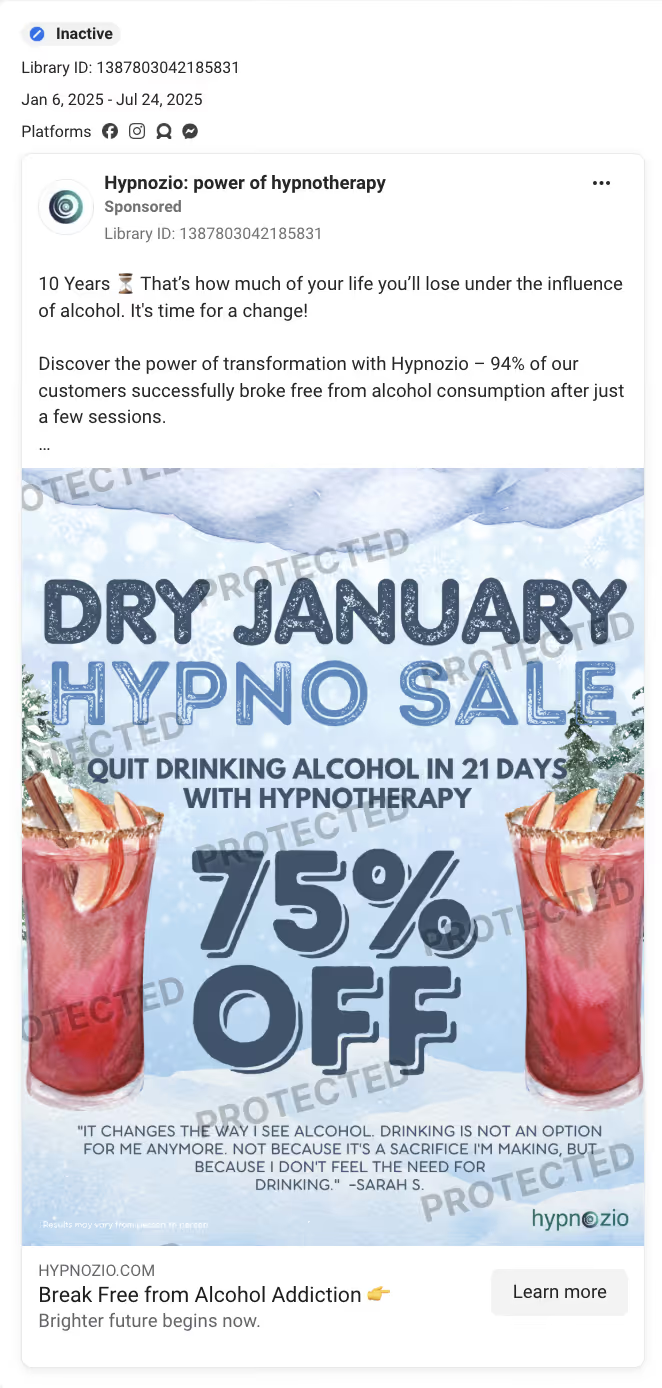
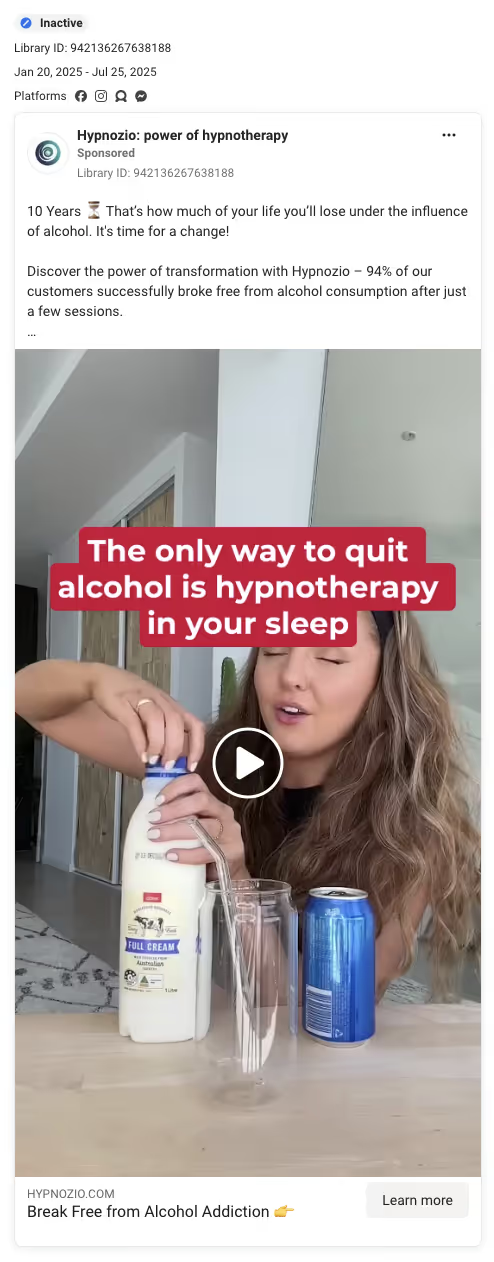
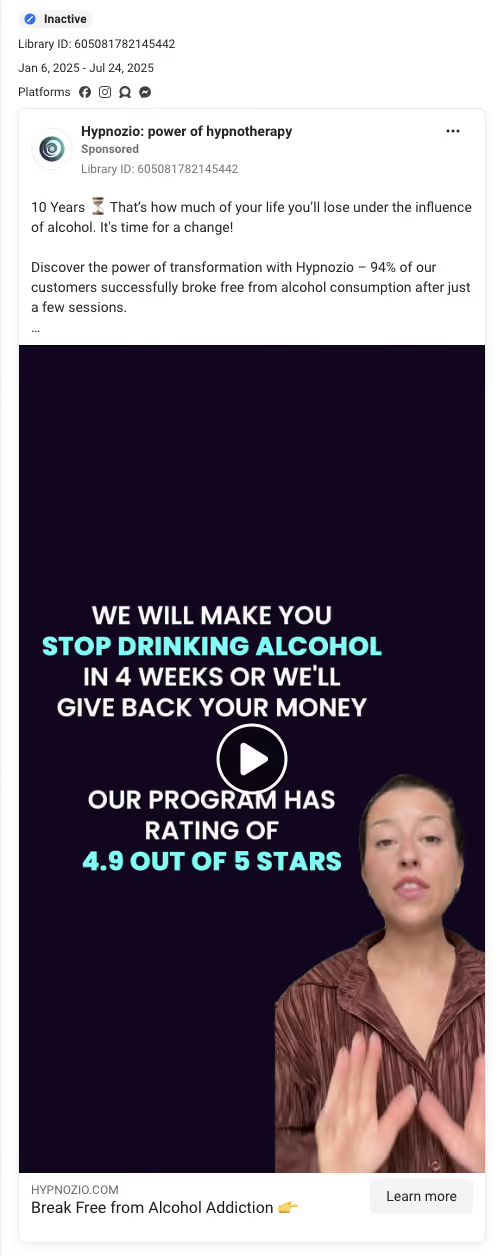
Weight and binge eating (3 ads)

Other notable data points
Threads placement appears in 42,801 of the 60,039 ads, which is an unusually early and widespread adoption of a relatively new placement. This suggests Hypnozio (or their agency) was actively testing Threads as a distribution channel while most advertisers were still ignoring it.
Ad creation volume is not uniform across the year. October and December are among the highest months, with 7,752 and 8,263 ads created respectively. January is the lowest at 422. This pattern suggests seasonal campaign pushes around year-end and post-holiday periods rather than a flat always-on approach.
URL parameters in the landing links include l= for language and vndr= for vendor or source tracking, which indicates structured attribution by language and campaign rather than a single catch-all destination.
What this tells us about scaling health apps on Meta in 2026
The Hypnozio playbook requires discipline to kill ads fast, creative clarity to keep hooks problem-specific, and the conviction to route all traffic through web funnels instead of the App Store.
Web2app funnels are exactly what web2wave builds. We design and optimize the full acquisition flow, from the ad hook through the quiz and landing page to conversion, for mobile apps that are serious about scaling on paid social.
If you want to see what a properly built web2app funnel could do for your app, book a call with our team.
Share this Article
Build your web funnel with web2wave
Start using web funnels: Launch faster, convert better, and keep more revenue with no app store limitations

.webp)